What Is a Cause List?#
A cause list is the official schedule of cases a court will hear on a given day. It is the single most important document for any lawyer or litigant who has a hearing coming up. In India, cause lists are published by the Supreme Court, every High Court, every District Court, and most tribunals — usually the evening before the hearing.
If you do not know how to read a cause list, you risk showing up at the wrong court number, at the wrong time, or missing your matter entirely because it was listed later than expected.
Anatomy of a Cause List#
A typical High Court cause list has these columns:
| Column | What It Means |
|---|---|
| Item No. | The order in which matters will be called (1, 2, 3…) |
| Case No. | e.g., W.P.(C) 12345/2025 |
| Parties | Petitioner vs Respondent |
| Advocate | Counsel appearing |
| Nature of Matter | Fresh / Admission / Regular / After Notice |
| Last Order | Brief note of the previous order, if any |
| Remarks | e.g., "Tagged with Item 7" |
Court Number
Each judge sits in a separate court number (Court No. 1, Court No. 2, etc.). In the Supreme Court, the CJI sits in Court No. 1. In a High Court, the Chief Justice typically sits in Court No. 1 and other judges in numbered courts thereafter.
Your cause list entry will tell you which court number to appear in. Walking into the wrong court is a rookie mistake that can lead to your matter being called in your absence.
Types of Cause Lists#
1. Daily Cause List
The main cause list for tomorrow. Usually published between 7 and 9 PM the previous evening.
2. Supplementary Cause List
Added matters that were not on the main list — often urgent mentions, matters taken up out of turn, or matters tagged late. Published later in the evening or early next morning.
Important: Many lawyers miss matters because they only check the main list. Always check for supplementary listings before leaving for court.
3. Advance Cause List
Some courts publish a list of matters to be heard over the next 1–2 weeks. Useful for planning but can change.
4. Weekly / Monthly Cause Lists
Some tribunals (NCLT, ITAT) publish weekly or monthly lists since their hearings are less frequent than constitutional courts.
How to Access Cause Lists#
Supreme Court
- Visit main.sci.gov.in/cause-list
- Choose date and court number
- Download the PDF
High Courts
Each High Court has its own portal. Examples:
- Delhi HC — delhihighcourt.nic.in → "Cause List"
- Bombay HC — bombayhighcourt.nic.in → "Case Information" → "Cause List"
- Madras HC — mhc.tn.gov.in → "Cause List"
- Karnataka HC — karnatakajudiciary.kar.nic.in
- Allahabad HC — allahabadhighcourt.in
District Courts
Cause lists are available on ecourts.gov.in → Cause List section, searchable by state, district and establishment.
Tribunals
NCLT, NCLAT, ITAT, CESTAT, SAT and others publish cause lists on their respective websites.
One Place Instead of Many
If your matters span multiple courts, the daily cause list page lets you pull tomorrow's board across High Courts and district courts from one screen — by court, bench, advocate or party name.
Reading Cause List Abbreviations#
Cause lists use shorthand that confuses first-time litigants:
| Abbreviation | Meaning |
|---|---|
| DB | Division Bench (two judges) |
| SB | Single Bench (one judge) |
| FB | Full Bench (three or more judges) |
| CB | Constitution Bench (five or more judges, SC) |
| Misc. | Miscellaneous matters |
| I.A. | Interlocutory Application |
| C.M. / CM Appl. | Civil Miscellaneous Application |
| For orders | Judgment or order to be pronounced |
| For arguments | Matter to be argued |
| For directions | Court to pass procedural directions |
| Part-heard | Hearing continued from earlier day |
| Fresh | First-time listing |
When Will My Matter Be Called?#
This is the hardest part of cause lists. Item numbers are not time slots — they are order of calling. A court may:
- Race through a list of 40 unopposed adjournment matters in 10 minutes
- Get stuck on Item No. 3 for four hours
- Skip ahead to Item No. 25 because counsel is ready
- Pass over your matter if you are absent (and recall it later, if you are lucky)
Practical rule of thumb for HCs and SC:
- Items 1–20: expect to be heard in the first half (10:30 AM – 1 PM)
- Items 20–50: likely afternoon (2:30 PM – 4 PM)
- Items 50+: reach court by 11 AM to be safe; often pushed to next day
How to Stop Missing Your Cause List#
Manually checking 4–5 court websites every evening is how lawyers burn their evenings. (For the full evening-to-morning routine — prep by item number, supplementary-list checks, client messages — see the daily cause list workflow for advocates.) Two faster options:
1. Evening Cause-List Digest (Lawyer Plan)
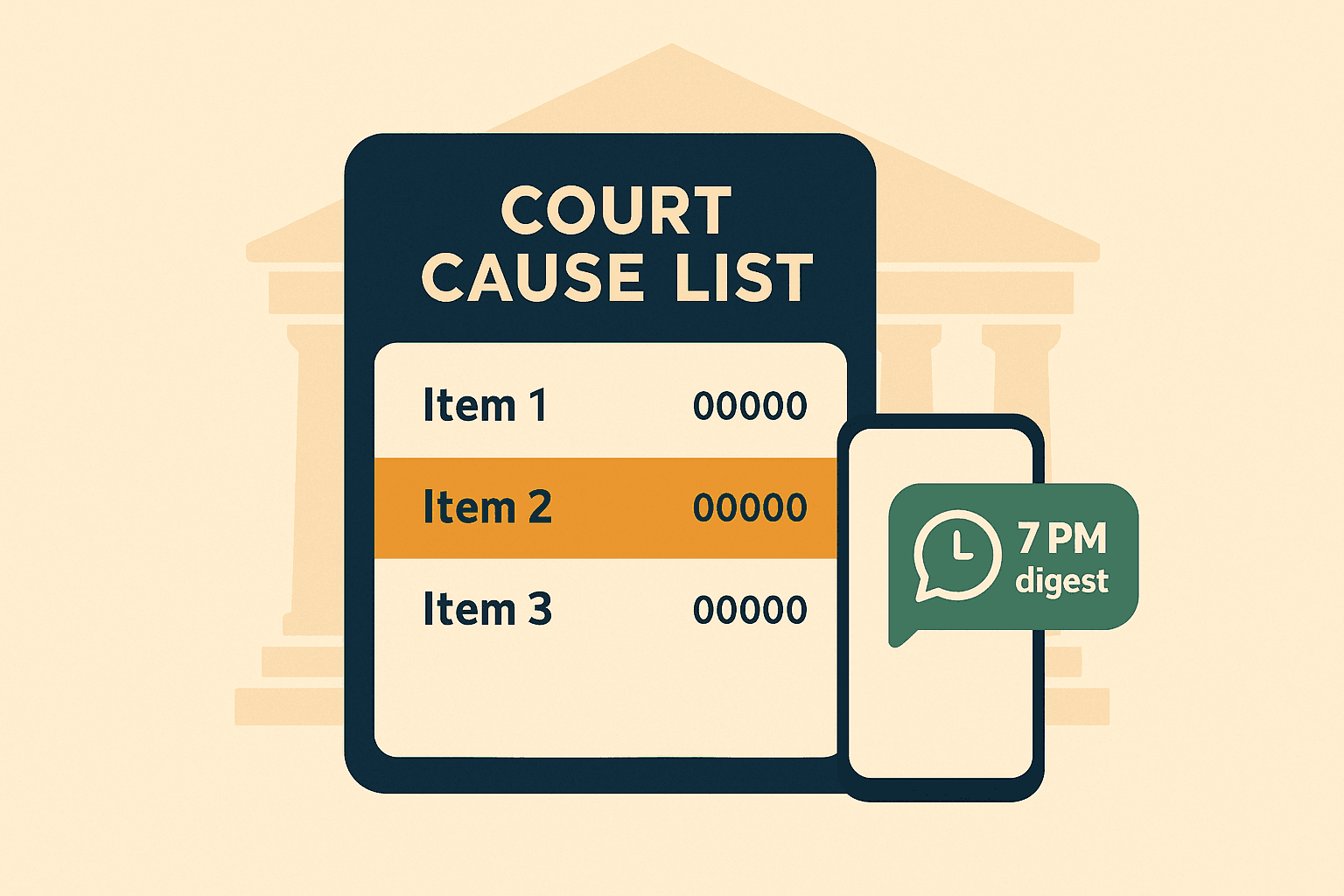
India Case Status is a full litigation management platform — dashboard, calendar, order archive, client sharing — and one of the features lawyers use most is the evening cause-list digest. Every working evening, you receive a single message with:
- All your matters listed for tomorrow
- Item number, court number, and judge
- A link to the court's official PDF cause list
- The same data synced into your hearing calendar (ICS) and dashboard
This is part of the standard lawyer and firm subscriptions. Start tracking →
2. Per-Case Hearing Reminders
Beyond the cause list, you also get per-case reminders:
- A reminder 7 days before the hearing
- A reminder 1 day before
- A morning-of reminder
This catches newly listed dates even if you haven't checked the cause list — and pairs with the dashboard and calendar where your full case history, notes and order PDFs live.
Tips for Reading Cause Lists Efficiently#
- 1Bookmark the cause list page for every HC where you practice
- 2Set a nightly reminder at 8 PM to check cause lists for the next day
- 3Always check the supplementary list — it is separate from the main list
- 4Note the court number — walking into the wrong courtroom is surprisingly common
- 5Identify "For Orders" matters early — they are called first in most courts
- 6If you are "Part-heard," your matter usually gets priority and is called early
- 7Cross-check with eCourts — sometimes the cause list entry and eCourts data differ; trust the cause list for the date, trust eCourts for the order copy
FAQs#
What time is the cause list published?
Typically 7–9 PM the previous evening. Supplementary lists may be published later or on the morning of the hearing.
Can a matter be heard even if it's not in the cause list?
Rarely — usually only for urgent mentions with prior permission of the Registrar. If your matter is not listed, it will not be heard.
What does "For Orders" mean?
The judge has reserved the matter and will pronounce the order. These matters are called first in most courts.
What is "Part-heard"?
The matter was heard partially on an earlier day and is now being continued. Part-heard matters usually get priority.
What does "cause list" mean?
A cause list is the official schedule of cases a court will hear on a particular day — the "board" for that courtroom. It shows each matter's item number, court number, judge, stage and the parties, and is usually published the evening before the hearing day.
How do I get tomorrow's cause list without checking each court website?
Check the daily cause list page for any court, or add your cases to India Case Status. On the Lawyer plan, the platform generates your personal cause-list digest every evening — delivered on WhatsApp/email, plus synced to your dashboard and hearing calendar. See plans for lawyers and firms.
Stop refreshing court websites at 9 PM. India Case Status is a full case tracking and litigation management platform — dashboard, hearing calendar with ICS export, order archive, client sharing, and yes, an evening cause-list digest. Start Tracking →