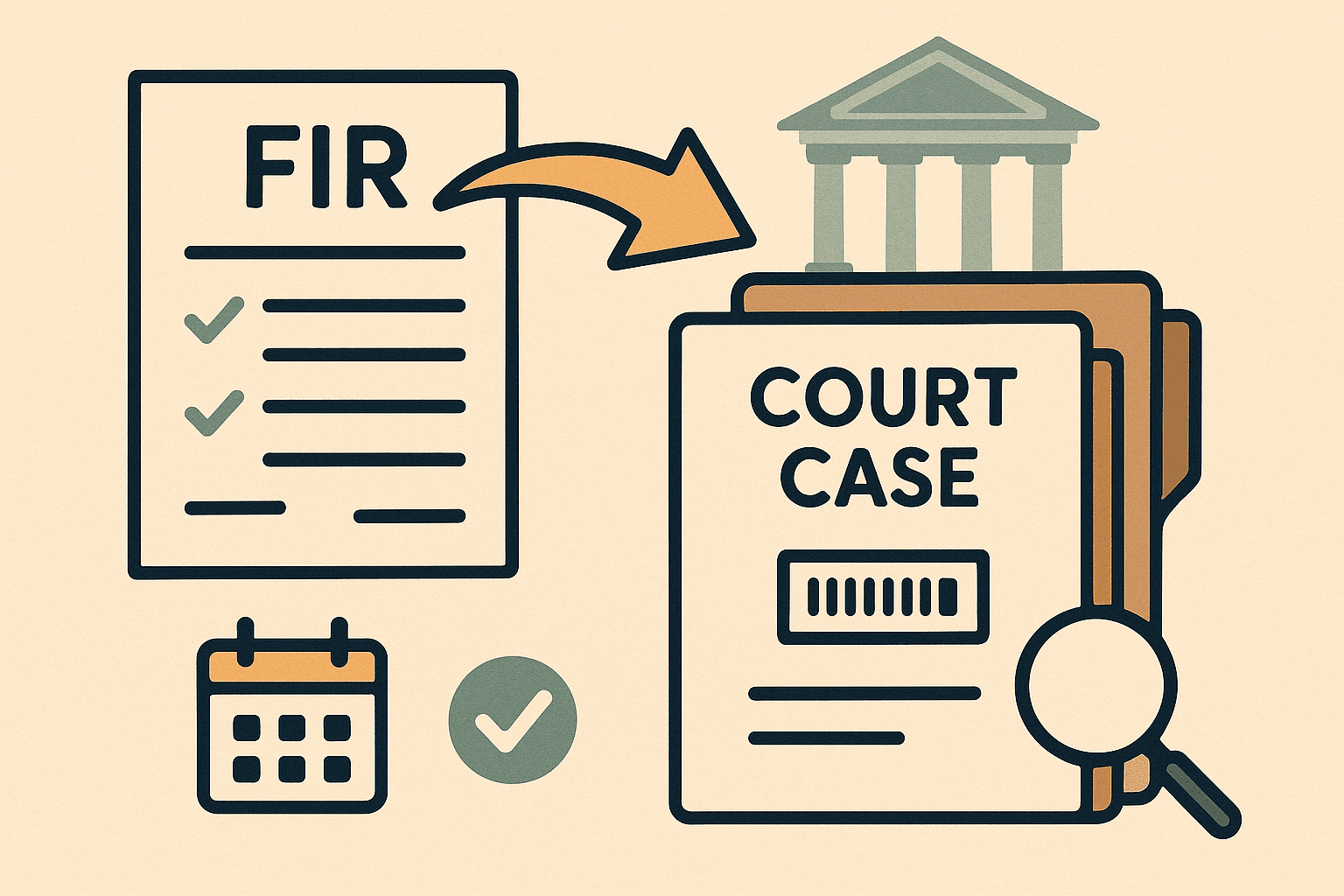
To find a court case by FIR number, open services.ecourts.gov.in, click Case Status and choose the FIR Number tab. Select the state, district and court, pick the police station, enter the FIR number and year, select Pending or Disposed, complete the CAPTCHA and click Go. The result shows the criminal case the FIR became, with hearing dates and orders.
From FIR to Courtroom: Why the Numbers Differ#
An FIR number is a police-station number, not a court number — and that distinction explains most failed searches. A criminal matter travels like this:
- 1FIR registered at the police station under Section 154 CrPC (Section 173 of the Bharatiya Nagarik Suraksha Sanhita for offences registered on or after 1 July 2024). The FIR gets a number such as 0123/2025, unique only within that police station and year.
- 2Investigation follows — statements, seizures, arrests, and bail proceedings if anyone is taken into custody.
- 3Chargesheet (the final report) is filed before the jurisdictional magistrate under Section 173 CrPC / Section 193 BNSS once the investigation is complete.
- 4Cognizance and registration — the court takes the matter on file and assigns it a court case number plus a 16-character CNR. This is the case your FIR "became".
- 5Committal — if the offence is triable exclusively by a Court of Session (murder, rape, dacoity and similar), the magistrate commits it under Section 209 CrPC / Section 232 BNSS and a sessions case number is assigned.
One police-station FIR can therefore spawn a magistrate case, a sessions case, bail applications and revisions — each with its own number. The eCourts FIR search is the bridge between the number you have and the case it produced.
How to Search a Case by FIR Number on eCourts#
- 1Open services.ecourts.gov.in and click Case Status.
- 2Select the State and District where the police station is located — not where the parties live.
- 3Choose the court establishment, or leave the broadest option selected if you are unsure.
- 4Click the FIR Number tab.
- 5Select the Police Station from the dropdown list.
- 6Enter the FIR number and the FIR year, then choose Pending, Disposed or Both.
- 7Complete the CAPTCHA, click Go, and click View on the result to open the case history — parties, charge sections, hearing dates, stage and orders.
Where the Matter Lives at Each Stage#
| Stage | Where the matter is | How to find it |
|---|---|---|
| FIR registered, investigation on | Police station | State police citizen portal for the FIR copy; nothing on eCourts yet |
| Chargesheet filed | Magistrate court | eCourts FIR Number search |
| Committed for trial | Court of Session | FIR search against the sessions establishment, or party name |
| Bail application | Magistrate, sessions court or High Court | Party-name search at the relevant court |
| Appeal or revision | Sessions court or High Court | Party-name search on the High Court portal |
A useful adjunct: in Youth Bar Association of India v. Union of India (2016), the Supreme Court directed that FIR copies be uploaded online within 24 hours of registration, with exceptions for sensitive offences. Most state police citizen portals therefore let you download the FIR itself — but the court case appears on eCourts only after the chargesheet.
If the FIR Search Returns Nothing#
The chargesheet has not been filed yet
A court case is born only when the chargesheet reaches the magistrate. Where the accused is in custody, the chargesheet is due within 60 or 90 days depending on the offence (Section 167 CrPC / Section 187 BNSS); where nobody has been arrested, investigations can run much longer. Until then, the FIR search has nothing to show.
Wrong police station selected
The dropdown lists stations by their official names, which sometimes differ from everyday usage — a locality nickname versus the formal station name, or a new station carved out of an old one. Try the neighbouring and parent stations too.
FIR year versus case year confusion
Enter the year the FIR was registered, not the year the chargesheet was filed. A December FIR often becomes a court case carrying the next year's number, so select Both rather than only Pending or only Disposed.
The case has been committed to the Court of Session
After committal, repeat the search against the sessions establishment for the same district. If the FIR link does not surface it, a party-name search on the accused or the complainant usually does.
A closure or untrace report was filed
If the police closed the investigation, there may be no prosecution case at all — only proceedings before the magistrate to accept or reject the closure report, sometimes registered under a miscellaneous case type. The informant is entitled to notice at this stage and can oppose the closure with a protest petition.
Found the Case? Lock On to the CNR#
The case page displays a 16-character CNR number — the identifier that stays with the case across hearings and stages. Save it: a CNR search takes seconds and skips every dropdown the FIR search makes you fill in. Our guide on how to find a CNR number shows where it appears on court documents.
Tracking the Magistrate or Sessions Case#
Criminal proceedings generate constant movement — remand dates, charge framing, evidence, exemption applications, bail orders — and hearing dates shift without warning. Checking the portal before every date works, but it relies on you remembering to check.
If the matter is in Delhi's district complexes, see the Tis Hazari court case status and Saket court case status pages, or the umbrella Delhi district court tracking guide. Across the NCR, the Noida court tracking page covers the Gautam Budh Nagar courts. And if bail is the immediate concern, our bail application status guide explains how bail matters are numbered and listed.
India Case Status takes the remembering out of it. Add the case once — by CNR, case number or party name — and the platform monitors it continuously against the official court record. New hearing dates, status changes and uploaded orders arrive as WhatsApp and email alerts in your choice of 10 Indian languages, while the dashboard keeps the full case history, order PDFs and hearing calendar in one place, with read-only sharing for clients and family.
Put the Case on Watch#
Whether you are the complainant tracking the prosecution or an accused tracking the next date, the worst way to learn about a hearing is after it has happened. Add the case once the chargesheet shows up on eCourts, and let the updates come to you.
Frequently Asked Questions#
Can I check an FIR's status online without visiting the police station?
Yes, in two layers. The FIR document itself is published on most state police citizen portals — the Supreme Court has directed upload within 24 hours of registration, with exceptions for sensitive offences. The court stage lives on eCourts: once a chargesheet is filed, the FIR Number search at services.ecourts.gov.in shows the criminal case, its hearing dates and orders.
How long after an FIR does a court case appear on eCourts?
Only after the police file a chargesheet and the court registers it. With an accused in custody, the chargesheet is due within 60 or 90 days depending on the offence; without an arrest, investigations can take months or longer. If the FIR search shows nothing, the matter is most likely still under investigation — check again periodically.
Is the FIR number the same as the case number or CNR?
No — they are three different identifiers. The FIR number is assigned by the police station and is unique only within that station and year. The case number is assigned by the court when it registers the chargesheet. The CNR is the 16-character eCourts identifier that is unique across India. The FIR search connects the first to the other two.
Can I find a sessions trial using the FIR number?
Usually, yes. Run the same FIR Number search and select the sessions court establishment for the district — committed cases retain their link to the originating FIR. If nothing appears, search by party name in the sessions establishment, or open the earlier magistrate-court record and follow the committal entry in its case history.
What happens if the police file a closure report instead of a chargesheet?
The magistrate can accept the closure, order further investigation, or take cognizance regardless. The informant must be given notice and can file a protest petition opposing the closure. These proceedings sometimes appear under a miscellaneous case type rather than a regular criminal number, so try both the FIR search and a party-name search to locate them.