To check high court case status, open the eCourts High Court Services portal at hcservices.ecourts.gov.in, select your high court and bench, and search by CNR number, case number or party name. Most of India's 25 high courts also run their own case-status pages with daily orders and display boards — this master guide covers every one of them.
India's 25 High Courts at a Glance#
High courts exist under Article 214 of the Constitution, one for each state — though several serve more than one state or union territory, and the newest, the Andhra Pradesh High Court at Amaravati, began functioning on 1 January 2019. Where a high court sits at benches away from its principal seat, your case belongs to the bench that covers your district, not the seat you find convenient.
| High Court | Principal Seat | Benches |
|---|---|---|
| Allahabad | Prayagraj | Lucknow |
| Andhra Pradesh | Amaravati | — |
| Bombay | Mumbai | Nagpur, Aurangabad, Goa |
| Calcutta | Kolkata | Port Blair, Jalpaiguri circuit benches |
| Chhattisgarh | Bilaspur | — |
| Delhi | New Delhi | — |
| Gauhati | Guwahati | Kohima, Aizawl, Itanagar |
| Gujarat | Ahmedabad | — |
| Himachal Pradesh | Shimla | — |
| Jammu & Kashmir and Ladakh | Srinagar / Jammu | — |
| Jharkhand | Ranchi | — |
| Karnataka | Bengaluru | Dharwad, Kalaburagi |
| Kerala | Kochi | — |
| Madhya Pradesh | Jabalpur | Indore, Gwalior |
| Madras | Chennai | Madurai |
| Manipur | Imphal | — |
| Meghalaya | Shillong | — |
| Orissa | Cuttack | — |
| Patna | Patna | — |
| Punjab & Haryana | Chandigarh | — |
| Rajasthan | Jodhpur | Jaipur |
| Sikkim | Gangtok | — |
| Telangana | Hyderabad | — |
| Tripura | Agartala | — |
| Uttarakhand | Nainital | — |
Each linked page above covers that high court's case-number conventions, portal quirks and how to set up tracking for it. The Punjab & Haryana High Court serves two states and Chandigarh; the Gauhati High Court serves Assam, Nagaland, Mizoram and Arunachal Pradesh through its outlying benches; and the Bombay High Court serves Maharashtra and Goa.
Two Ways to Check: eCourts HC Services vs the Court's Own Website#
There are two official routes to any high court case, and knowing both saves you when one is slow or incomplete.
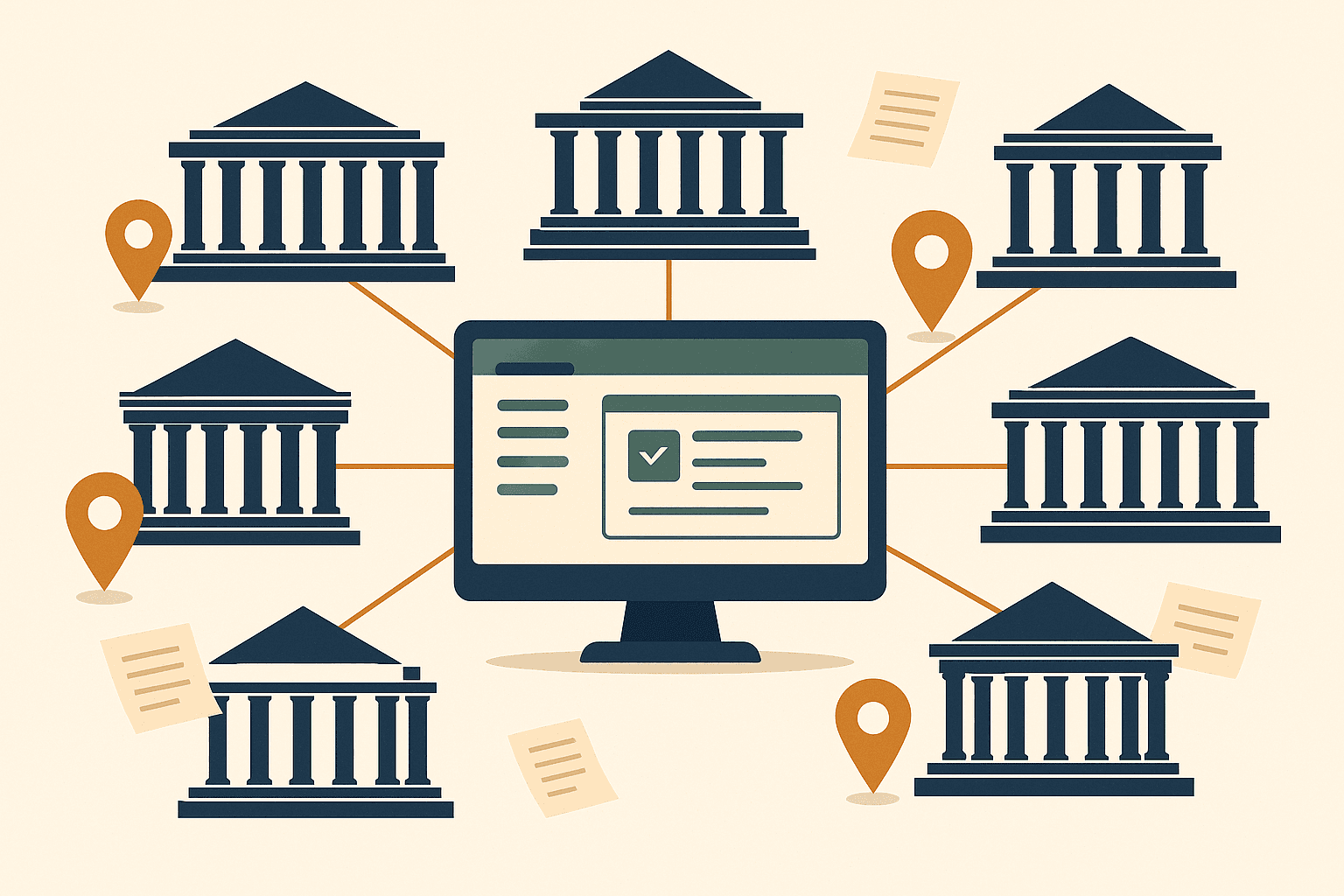
The eCourts High Court Services portal (hcservices.ecourts.gov.in) is the common interface: pick the high court, pick the principal seat or bench, and search by case number, CNR, party name, advocate name, filing number or even FIR number on the criminal side. The layout is identical for every court, which makes it the easiest starting point.
Most high courts additionally run their own websites — delhihighcourt.nic.in, bombayhighcourt.nic.in, allahabadhighcourt.in, mhc.tn.gov.in and so on — with case status, daily orders, judgment search and live display boards. These in-house systems often carry richer detail: Delhi publishes orders with neutral citations, Bombay distinguishes stamp numbers from registration numbers for newly filed matters, and several courts stream a live board showing the item currently being heard in each courtroom.
If a search fails on one route, try the other before concluding the case is not online.
CNR Number vs Case Number#
Every case in the eCourts ecosystem carries a unique 16-character CNR number — for example, DLHC01-001234-2026 — which identifies the court, a serial number and the year. Searching by CNR skips every dropdown and works the same way for all 25 high courts, which is why it is the identifier worth saving the day your case is filed. Our guide on how to find your CNR number shows where it appears on filings and case pages.
Case numbers, by contrast, are court-specific: a writ petition is W.P.(C) 4321/2026 in Delhi, WP 4321/2026 in Madras, and a numbered category of its own in courts that follow different registry conventions. Appeals, criminal matters and original-side suits each carry their own prefixes — CRL.A., FAO, RFA, CS(COMM) and dozens more — and the case-type dropdown on each portal reflects that court's list. If a case-number search fails, the usual culprit is the wrong case-type code, not a missing case.
How to Check High Court Case Status (Step by Step)#
- 1Open hcservices.ecourts.gov.in and click Case Status.
- 2Select the high court and then the principal seat or bench where the matter is filed.
- 3Choose a search mode — CNR, case number, party name, advocate name, filing number or FIR number.
- 4Fill in the details with the year, enter the CAPTCHA shown on screen and submit.
- 5Open the result to see the case history: filing and registration details, listing dates with the business recorded on each, connected matters, IA status and uploaded orders.
For orders and judgments specifically — including certified copies — see our walkthrough on downloading court orders and judgments online.
Cause Lists: Tomorrow's Board#
A case-status page tells you what happened; the cause list tells you what happens tomorrow. Every high court publishes a daily cause list — usually the evening before — showing item number, court number and judge for each listed matter, often with a supplementary list added later. Our cause list guide explains how to read item numbers, bench abbreviations like DB and SB, and why your item number is not a time slot.
Tracking Cases Across High Courts From One Dashboard#
Checking one writ petition occasionally is easy. The pain starts when matters spread across courts — an appeal at the principal seat, a connected writ at a bench, a client's matter in another state — each with its own portal, case-number format and orders page.
India Case Status is a case tracking and litigation management platform that absorbs that variety: add any high court matter by CNR, case number or party name through the Smart Case Finder, and the platform monitors it continuously against the official court record. Every matter lands on one dashboard with its stage and next date, every uploaded order is archived as a PDF, hearings flow into a calendar with ICS export, and alerts go out on WhatsApp and email in 10 Indian languages. Lawyers can share a read-only link with clients, and teams get a shared workspace. The high court case status hub links out to every court-specific guide.
Check and Track Your High Court Case#
Your case already lives on the official record of one of these 25 courts — the only question is whether you go fetch every update or have updates come to you. Add your high court case by CNR, case number or party name, and stay current from filing to final order.
Frequently Asked Questions#
How many high courts are there in India in 2026?
India has 25 high courts. The newest is the Andhra Pradesh High Court at Amaravati, which began functioning on 1 January 2019 after the common high court at Hyderabad was bifurcated, with the Telangana High Court as its successor in Hyderabad. Several high courts serve multiple states or union territories — Punjab and Haryana share one, and the Gauhati High Court covers four north-eastern states.
Can I check high court case status by party name?
Yes. On hcservices.ecourts.gov.in, select the high court and bench, open the party-name search, and enter the petitioner's or respondent's name with the year and a pending or disposed filter. High courts with their own status pages — Delhi, Bombay, Madras and others — offer similar party searches. Verify the opposite party's name in the results, since common names can return dozens of matches.
What is the CNR number of a high court case?
The CNR is a unique 16-character identifier assigned to every case in the eCourts ecosystem, including high court matters — for example, DLHC01-001234-2026 encodes the court, a serial number and the year. It appears on filings and on the case-status page itself. Searching by CNR skips every dropdown and works identically across portals, making it the fastest way to pull up a high court case.
Are all high courts covered on the eCourts portal?
The eCourts High Court Services portal covers the high courts and their benches in one standard interface, and it is the simplest place to start. In parallel, most high courts maintain their own websites with case status, daily orders, judgment search and display boards, which often carry richer detail. If a search fails on one route, try the other before assuming the case is not online.
How do I know which bench of a high court handles my case?
Where a high court has benches, jurisdiction is divided by district. A matter arising in Madurai district goes to the Madurai bench of the Madras High Court, a Vidarbha matter to the Nagpur bench of the Bombay High Court, and an Avadh-region matter to the Lucknow bench of the Allahabad High Court. Your case number and the cause list both indicate the bench, and the eCourts portal lists each bench separately.
How can I track cases in more than one high court at once?
Checking several high court websites every day does not scale. India Case Status lets you add matters from any high court — by CNR, case number or party name — and see them all on one dashboard with a combined hearing calendar, an order PDF archive, client sharing and alerts on WhatsApp and email. Start from the high court case status hub and pick your court.